
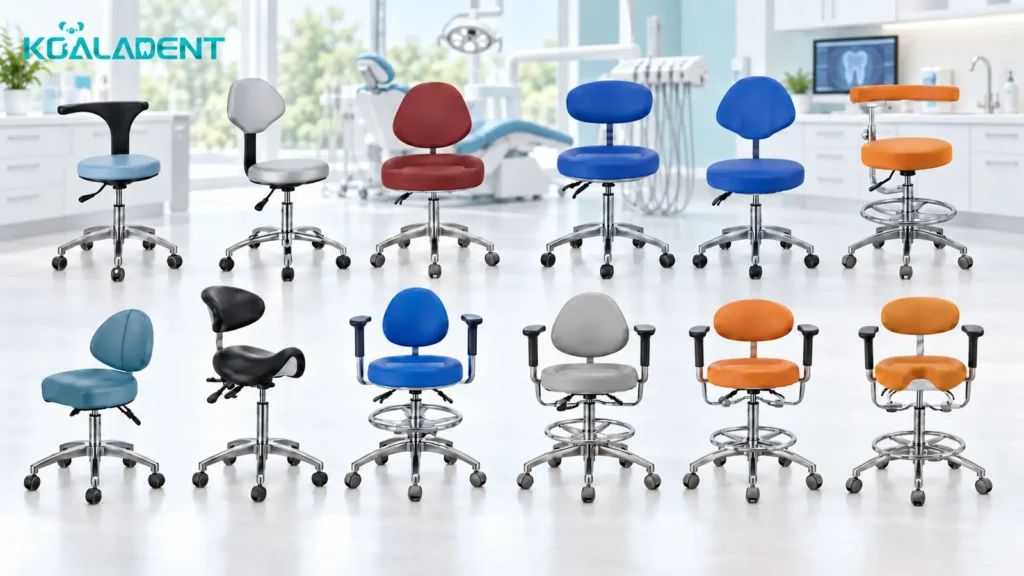
The right ergonomic dental stool helps clinicians work comfortably, move efficiently around the patient, and adapt their sitting position to different procedures. This guide compares 12 KOALADENT dental stool models and explains how seat shape, working height, back support, arm supports, and foot rings affect everyday use.
Why the Right Dental Stool Matters
Dentists, hygienists, and assistants often lean forward, rotate, and move between instruments during treatment. A poorly matched stool can restrict movement or make it harder to maintain a balanced working position.
An ergonomic dental stool combines adjustable height, smooth rotation, stable support, and easy mobility. In our experience supplying dental clinics, buyers often compare height first, but seat shape and support configuration have a greater effect on everyday comfort.
Which Dental Stool Design Should You Choose?
Compact Stools for Easy Movement
Compact stools are practical for users who want unrestricted movement and a smaller footprint. KL-DS01 is the lightest model in the range at approximately 9.5 kg and adjusts from 380 to 550 mm, making it suitable when a lower sitting position is required.
KL-DS02 provides a simple 430–550 mm adjustable design. Both configurations work well in multipurpose rooms, laboratories, and assistant work areas.
Dental Stools with Backrests
KL-DS03, KL-DS04, and KL-DS05 add padded back support to a conventional adjustable seat. A dental stool with backrest may suit clinicians who alternate between forward-working positions and more upright tasks.
Their different cushion profiles let buyers choose a rounded or more contoured design while retaining the same main height range.
Models with Foot Rings
KL-DS06 combines a padded seat, back support, and circular foot ring. This dental operator stool provides an alternative foot position when used at an elevated height.
Contoured and Saddle Seats
KL-DS07 features a sculpted cushion and padded backrest for users who prefer a more defined seating position. KL-DS08 uses a saddle-style seat and a 160 mm gas lift, with an elevated seat-height range of 630–790 mm.
A dental saddle stool creates a more open hip position but may require an adjustment period. Choose KL-DS08 only after confirming that its elevated range matches the user and dental unit.
Models with Bilateral Arm Supports
KL-DS09, KL-DS10, KL-DS11, and KL-DS12 include bilateral arm supports, padded seating, and circular foot rings. The adjustable supports can provide additional positioning options during detailed clinical work.
KL-DS12 has a stronger saddle-style contour; the others use rounded or gently shaped seats. This group suits buyers who prioritize multi-point support.
Dental Stool Specification Comparison
| Model | Gas Lift | Wheel Diameter | Base Diameter | Seat Height | Gross Weight |
|---|---|---|---|---|---|
| KL-DS01 | 120 mm | 60 mm | 600 mm | 380–550 mm | 9.5 kg |
| KL-DS02 | 120 mm | 60 mm | 600 mm | 430–550 mm | 10.5 kg |
| KL-DS03 | 120 mm | 60 mm | 600 mm | 430–550 mm | 12.5 kg |
| KL-DS04 | 120 mm | 60 mm | 600 mm | 430–550 mm | 12.5 kg |
| KL-DS05 | 120 mm | 60 mm | 600 mm | 430–550 mm | 12.5 kg |
| KL-DS06 | 120 mm | 60 mm | 600 mm | 430–550 mm | 14 kg |
| KL-DS07 | 120 mm | 60 mm | 600 mm | 430–550 mm | 12.5 kg |
| KL-DS08 | 160 mm | 60 mm | 630 mm | 630–790 mm | 14 kg |
| KL-DS09 | 120 mm | 60 mm | 600 mm | 430–550 mm | 15 kg |
| KL-DS10 | 120 mm | 60 mm | 600 mm | 430–550 mm | 15 kg |
| KL-DS11 | 120 mm | 60 mm | 600 mm | 430–550 mm | 15 kg |
| KL-DS12 | 120 mm | 60 mm | 600 mm | 430–550 mm | 15 kg |
Five Factors to Check Before Ordering
1. Working Height
Match the stool to the patient chair, treatment unit, and user. Most models adjust from 430–550 mm; KL-DS01 reaches 380 mm, while KL-DS08 is designed for elevated work at 630–790 mm.
2. Seat Shape
A conventional cushion feels familiar and permits easy movement. A contoured or saddle seat creates a more defined position. Choose the ergonomic dental stool the operator can use naturally.
3. Back and Arm Support
A compact stool maximizes movement. A backrest supports upright work, while bilateral arm supports provide positioning options during precision tasks. Select only the support the operator needs.
4. Foot Position
At higher settings, a circular foot ring provides an alternative support point. Check that the dental assistant stool permits a relaxed leg position.
5. Stability and Mobility
A five-star base supports balance while casters provide mobility. All models use 60 mm wheels; most have a 600 mm base, while KL-DS08 uses a 630 mm base. Confirm compatibility with the clinic’s flooring.
Quick Model Recommendations
- Choose KL-DS01 for a lightweight design and lower minimum height.
- Choose KL-DS02 for straightforward, general-purpose seating.
- Choose KL-DS03, KL-DS04, or KL-DS05 for padded back support.
- Choose KL-DS06 when an integrated foot ring is essential.
- Choose KL-DS07 for a sculpted seat and backrest.
- Choose KL-DS08 for elevated saddle seating.
- Choose KL-DS09, KL-DS10, or KL-DS11 for arm supports and a foot ring.
- Choose KL-DS12 for arm support with a stronger saddle-style contour
Frequently Asked Questions
What is the standard seat-height range?
Most models adjust from 430 to 550 mm. KL-DS01 offers a lower 380–550 mm range, while KL-DS08 provides elevated adjustment from 630 to 790 mm.
Do the stools rotate 360 degrees?
Yes. The stools are designed for smooth 360-degree rotation, helping users reach instruments and change direction around the patient.
Is a saddle seat better than a conventional seat?
A saddle seat creates a more open hip position, while a conventional cushion feels familiar and allows easy movement. Choose according to the operator’s posture and working habits.
When should I choose arm supports?
Arm supports provide positioning options during detailed procedures. Clinicians who prioritize free movement may prefer a simpler dental doctor stool.
How should the upholstery be cleaned?
Use a soft cloth and an upholstery-compatible cleaner. Avoid abrasives and aggressive chemicals, and follow the supplied care instructions.
Find the Right Stool for Your Clinic
The best ergonomic dental stool should match the operator’s height, sitting preference, clinical role, and available workspace. Compare the adjustment range first, then decide whether a backrest, saddle seat, arm supports, or foot ring will deliver a practical benefit.
Explore our range of ergonomic dental stools designed for dentists, hygienists and dental assistants. Available options include standard operator stools, saddle stools, backrest stools and models with arm supports or foot rings.


 EN
EN FR
FR AR
AR ES
ES