
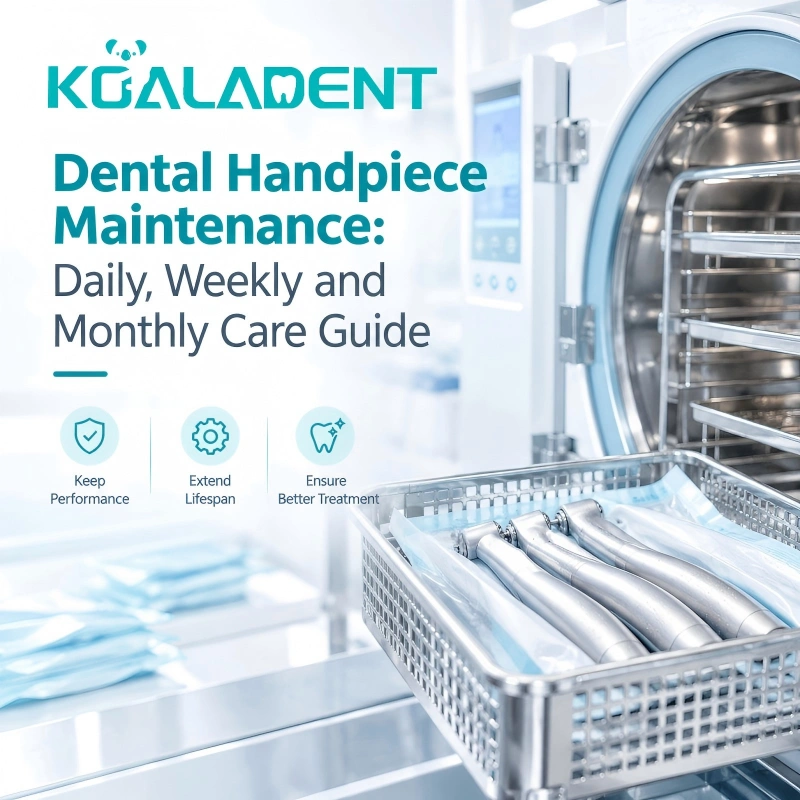
A dental handpiece is used repeatedly throughout the working day, often under demanding clinical conditions. Water, debris, heat, lubrication and sterilization cycles can all affect its performance over time.
For this reason, dental handpiece maintenance should not be treated as an occasional task. A simple maintenance routine can help reduce avoidable problems, keep handpieces working consistently and extend their usable service life.
Whether you are managing a small dental clinic or purchasing equipment for several treatment rooms, it is worth establishing a clear routine for cleaning, lubrication, sterilization and inspection.
This guide explains a practical approach to dental handpiece care, from daily cleaning to weekly inspection and monthly checks.
Important: Exact cleaning, lubrication and sterilization procedures vary between handpiece models. Always follow the manufacturer’s instructions for the specific instrument you are using.
Why Is Dental Handpiece Maintenance Important?
A dental handpiece contains precision components that operate at high speed. During treatment, the instrument can come into contact with water, saliva, tooth debris and other contaminants.
Without proper cleaning and maintenance, several problems can develop over time, including:
- Reduced cutting performance
- Unusual noise or vibration
- Overheating
- Water or air flow problems
- Chuck or bur retention issues
- Premature bearing wear
- Shorter service life
Maintenance is also an important part of instrument reprocessing. Manufacturer guidance commonly includes cleaning, lubrication and sterilization as part of the handpiece care process. For example, KaVo recommends cleaning, lubrication and autoclave sterilization as part of its handpiece reprocessing procedure.
The exact process should always follow the instructions supplied with your particular handpiece.
Daily Dental Handpiece Maintenance
For most dental clinics, daily care should be built into the normal instrument reprocessing workflow rather than left until the end of the week.
A basic routine can include:
1. Remove the Bur After Use
After treatment, remove the bur according to the manufacturer’s recommended procedure.
Do not leave a bur installed unnecessarily during storage or reprocessing.
This also gives the operator an opportunity to check the chuck and bur-retention system for visible debris or unusual wear.
2. Clean the External Surface
Remove visible contamination from the outside of the handpiece.
Use the cleaning method recommended by the manufacturer. Some handpieces should not be immersed in water or disinfectant, so avoid assuming that every instrument can be cleaned in the same way.
For example, KaVo’s published care instructions specifically advise cleaning the external surface under running water while avoiding immersion in disinfectant or chemical solutions.
This is one reason why having the correct maintenance instructions available for each handpiece model is important.
3. Check the Water and Air Spray
Before the next clinical use, check that the water and air spray are working normally.
Pay attention to:
- Weak water spray
- Uneven spray
- Blocked spray ports
- Unusual air flow
- Water leakage
If the spray pattern suddenly changes, don’t simply increase pressure or continue using the instrument without checking the cause.
A blocked spray port, connection problem or internal issue may require cleaning or professional service.
Dental Handpiece Lubrication
Lubrication is one of the most important parts of routine handpiece maintenance.
High-speed and low-speed handpieces contain moving components that require appropriate lubrication according to the manufacturer’s instructions.
Depending on the handpiece design, lubrication may be required for areas such as:
- Bearings
- Gears
- Chuck mechanisms
- Internal moving components
- Handpiece heads
KaVo’s maintenance guidance, for example, describes lubrication as part of the reprocessing procedure and notes that lubrication supports the working life of components such as bearings, gears and chucking systems.
How Often Should a Dental Handpiece Be Lubricated?
There is no single frequency that applies to every handpiece.
The correct frequency depends on:
- Handpiece model
- Manufacturer instructions
- Frequency of use
- Type of procedure
- Cleaning and sterilization workflow
- Lubrication system being used
For some systems, lubrication is performed as part of reprocessing after use and before sterilization. Other handpieces may have different requirements.
Do not assume that more lubricant is always better.
Excess lubricant can remain inside the instrument and may affect subsequent operation. After lubrication, follow the manufacturer’s recommended procedure for removing excess oil and preparing the handpiece for sterilization.
High-Speed vs Low-Speed Handpiece Maintenance
The maintenance principle is similar, but the construction and clinical use of high-speed and low-speed handpieces are different.
High-Speed Handpieces
High-speed handpieces are commonly used for procedures requiring rapid rotary cutting.
Maintenance should pay particular attention to:
- Turbine or bearing performance
- Chuck condition
- Water spray
- Air supply
- Unusual vibration
- Lubrication requirements
If a high-speed handpiece suddenly becomes noisy or develops noticeable vibration, it should be inspected rather than simply continuing to operate it.
Low-Speed Handpieces
Low-speed systems are commonly used for procedures where different speeds and torque characteristics are required.
Their maintenance may involve the handpiece itself as well as compatible contra-angle or other attachments.
KOALADENT’s external low-speed dental handpiece with fiber optic is an example of a low-speed handpiece designed for dental clinical applications.
External Low-Speed Dental Handpiece with Fiber Optic
When selecting or maintaining a low-speed handpiece, clinics should consider compatibility with the motor and attachments, cleaning requirements, lubrication procedure and sterilization instructions.
Dental Handpiece Sterilization
Cleaning and sterilization are separate steps and should not be treated as the same process.
A typical workflow may include:
Cleaning → Lubrication → Packaging → Sterilization → Drying → Storage
However, the exact sequence depends on the manufacturer’s instructions and the equipment used by the clinic.
For heat-tolerant dental handpieces, autoclave sterilization is commonly part of the reprocessing procedure. KaVo, for example, states that its handpieces should be sterilized by autoclaving after each patient, following the relevant manufacturer and professional guidance.
The autoclave itself also needs to be maintained correctly.
For clinics looking for an appropriate sterilization solution, KOALADENT offers the 8L/12L Class B Dental Autoclave with LCD KL-FOSTER-02.
8L/12L Class B Dental Autoclave with LCD KL-FOSTER-02
When choosing an autoclave for a dental clinic, consider:
- Chamber capacity
- Sterilization class
- Cycle requirements
- Drying performance
- Instrument compatibility
- Daily workload
- Maintenance and service requirements
The autoclave should be selected according to the clinic’s actual instrument volume and reprocessing workflow rather than simply choosing the largest available chamber.
Can an Ultrasonic Cleaner Be Used for Dental Handpieces?
An ultrasonic cleaner can be useful for cleaning certain dental instruments and accessories, but it should not automatically be assumed that every dental handpiece can be placed in an ultrasonic cleaner.
Always check the manufacturer’s instructions first.
Ultrasonic cleaning is particularly useful for removing debris from compatible instruments and hard-to-reach surfaces.
For clinics that use ultrasonic cleaning as part of their instrument processing workflow, KOALADENT offers the 6L Dental Ultrasonic Cleaner KL-CD-4862.
6L Dental Ultrasonic Cleaner KL-CD-4862
The important point is that an ultrasonic cleaner should be considered as one part of the cleaning workflow, not as a replacement for the complete cleaning, disinfection and sterilization process.
Weekly Dental Handpiece Maintenance Checklist
In addition to daily care, clinics should schedule a more detailed inspection at least periodically.
A weekly checklist can include:
✓ Check the Chuck
Inspect the bur retention system and look for signs of wear or contamination.
✓ Check for Unusual Noise
A change in operating sound can be an early indication of bearing or internal component problems.
✓ Check Vibration
Excessive vibration should not be ignored.
✓ Inspect Water Spray
Check whether the spray is even and consistent.
✓ Check Connections
Inspect the connection between the handpiece and the dental unit or motor.
✓ Review Lubrication
Make sure the lubrication procedure is being followed correctly.
✓ Check External Condition
Look for cracks, damage, corrosion or other visible abnormalities.
Some manufacturers recommend specific recurring maintenance tasks for the chucking system. For example, KaVo recommends cleaning and servicing the chuck system weekly, while also noting that more frequent care may be appropriate under intensive use.
Again, the maintenance schedule for your handpiece should follow its own manufacturer’s instructions.
Monthly Dental Handpiece Maintenance
Monthly checks can be used to identify problems that may not be obvious during normal daily cleaning.
Depending on the clinic’s workload, consider reviewing:
- Overall handpiece performance
- Chuck retention
- Water and air spray
- Noise and vibration
- Fiber optic performance, where applicable
- Connection condition
- Lubrication process
- Sterilization records
- Repair history
For clinics with high handpiece usage, waiting until a noticeable failure occurs can lead to unexpected downtime.
A simple maintenance record can help identify recurring problems.
For example:
| Date | Handpiece | Maintenance | Problem Found | Action |
|---|---|---|---|---|
| Sept. 5 | Low-Speed #01 | Cleaning + Lubrication | None | Normal |
| Sept. 12 | High-Speed #03 | Inspection | Weak spray | Checked |
| Sept. 20 | Low-Speed #01 | Inspection | Noise | Service required |
This is particularly useful for clinics with multiple treatment rooms.
Common Dental Handpiece Problems
1. The Handpiece Becomes Noisy
Possible causes can include wear, insufficient lubrication, contamination or internal component problems.
Don’t assume that adding more lubricant will solve every noise issue.
If the noise continues, the handpiece should be inspected according to the manufacturer’s service procedure.
2. The Handpiece Vibrates
Unusual vibration may be associated with the bur, chuck, bearings or other internal components.
First check the simple causes, such as correct bur installation and visible damage.
If the vibration remains, professional inspection may be required.
3. Water Spray Is Weak
Check the water supply, connections and spray ports according to the equipment instructions.
A partially blocked spray port can affect cooling performance.
4. The Bur Does Not Lock Properly
This is an issue that should not be ignored.
The chucking mechanism needs to hold the bur securely. If retention becomes unreliable, remove the handpiece from clinical use and follow the manufacturer’s inspection or repair procedure.
When Should You Replace a Dental Handpiece?
Maintenance can extend the working life of a handpiece, but every instrument eventually reaches a point where repair or replacement makes more sense.
Consider service or replacement when you repeatedly experience:
- Excessive noise
- Persistent vibration
- Poor cutting performance
- Repeated chuck problems
- Water leakage
- Unstable performance
- Frequent repairs
- High maintenance costs
The decision should be based on the condition of the instrument, repair cost, expected service life and clinical requirements—not simply on how old the handpiece is.
A Simple Dental Handpiece Maintenance Routine
For a busy dental clinic, the following routine can be a practical starting point:
After Each Use
Clean → Inspect → Lubricate according to instructions → Prepare for sterilization
Daily
Check spray → Check connections → Confirm normal operation
Weekly
Inspect chuck → Check noise and vibration → Review lubrication and cleaning procedures
Monthly
Review overall condition → Check maintenance records → Identify instruments requiring service
The exact process should always be adapted to the manufacturer’s instructions for each handpiece.
Build a Complete Instrument Reprocessing Workflow
Dental handpiece maintenance works best when it is part of a broader instrument reprocessing system.
A typical workflow may involve:
Treatment → Cleaning → Instrument Processing → Lubrication → Sterilization → Drying → Storage → Clinical Use
For compatible instruments, an ultrasonic cleaner can support the cleaning stage, while a suitable autoclave handles sterilization.
For example, KOALADENT’s equipment portfolio includes:
Low-Speed Dental Handpiece
→ For clinical rotary procedures
6L Dental Ultrasonic Cleaner KL-CD-4862
→ For compatible instrument cleaning
8L/12L Class B Dental Autoclave KL-FOSTER-02
→ For sterilization
This combination can form part of a broader dental clinic instrument-processing workflow, with the exact process determined by the manufacturer’s instructions and the clinic’s infection-control procedures.
Frequently Asked Questions
How often should a dental handpiece be lubricated?
The frequency depends on the handpiece model, usage and manufacturer’s instructions. Many maintenance systems include lubrication as part of the reprocessing procedure, but clinics should follow the specific instructions supplied with their instrument.
Can dental handpieces go into an autoclave?
Many heat-tolerant dental handpieces are designed for autoclave sterilization, but compatibility and cycle requirements vary. Always check the manufacturer’s instructions before sterilization.
Can I put a dental handpiece in an ultrasonic cleaner?
Not necessarily. Some handpieces should not be processed in an ultrasonic cleaner. Check the manufacturer’s instructions before using ultrasonic cleaning.
Why is my dental handpiece making a strange noise?
Possible causes include wear, insufficient lubrication, contamination, bearing problems or other mechanical issues. If the noise persists after the recommended maintenance procedure, the handpiece should be inspected.
How can I extend the life of a dental handpiece?
Follow the manufacturer’s cleaning and lubrication instructions, sterilize correctly, avoid improper chemicals or processing methods, and inspect the handpiece regularly.
Final Thoughts
Good dental handpiece maintenance does not have to be complicated.
The most important thing is consistency.
Clean the instrument correctly, use the recommended lubrication procedure, follow the appropriate sterilization process and check for early signs of wear. A simple maintenance routine can help dental clinics reduce avoidable equipment problems and keep their instruments ready for clinical use.
For clinics planning their complete equipment and instrument-processing workflow, choosing compatible cleaning and sterilization equipment is just as important as choosing the handpiece itself.
Explore KOALADENT’s dental equipment solutions and build an equipment setup around your clinic’s actual workflow and requirements.



 EN
EN FR
FR AR
AR ES
ES